
GSD: How a Small Team Outpaces the Competition
I'm not someone who likes acronyms. Most of the time they cause more confusion than clarity, and half the people using them couldn't tell you what they actually stand for. But there is one I'm happy to stand behind. At Sketch, our process comes down to three letters: GSD.
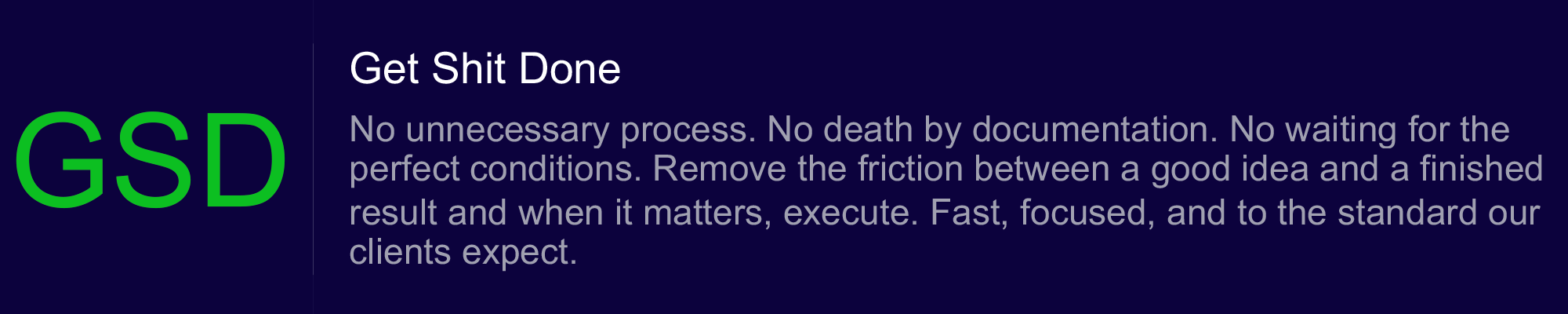
We are a small team. That means we have to outperform and outpace our competition, including engineering teams with far greater headcount and resource. Working harder isn't the answer. Working smarter is. Staying at the forefront of design and engineering isn't optional for us; it's our USP. A modern, efficient team is the product we're selling. And whenever we take on a new project, GSD is the standard we hold ourselves to.
It starts with the people
GSD isn't just a process. It starts with the team. We might be small, but we operate with the combined knowledge and skills of people who genuinely back each other. Collaboration at Sketch doesn't just mean working together on a shared brief. It means covering for each other when it counts.
When one of us gets pulled in another direction, and in a consultancy that happens, the others are there to make sure the project stays on track. Nobody drops the ball because nobody is carrying it alone. That kind of agility and mutual accountability is something larger teams, by their very structure, struggle to replicate. It's one of the advantages of being small, and we lean into it deliberately.
The tools that make GSD possible
People are the foundation. But the tools are what multiply our output. The AI systems we've built into our workflow aren't experiments or bolt-ons. They're the infrastructure that allows a small team to operate like a much larger one, without the overhead that comes with size.
Claude sits at the centre of it. Every project runs through it. It's our single point of contact for information, keeping context coherent across the team and across the life of a project. Here's what that looks like in practice:

While AI is running, we're designing. That's the point. AI handles the process; we focus on the thinking. The result is a team that produces at a level that simply wouldn't be possible if we were doing everything manually.
Human in the loop, always
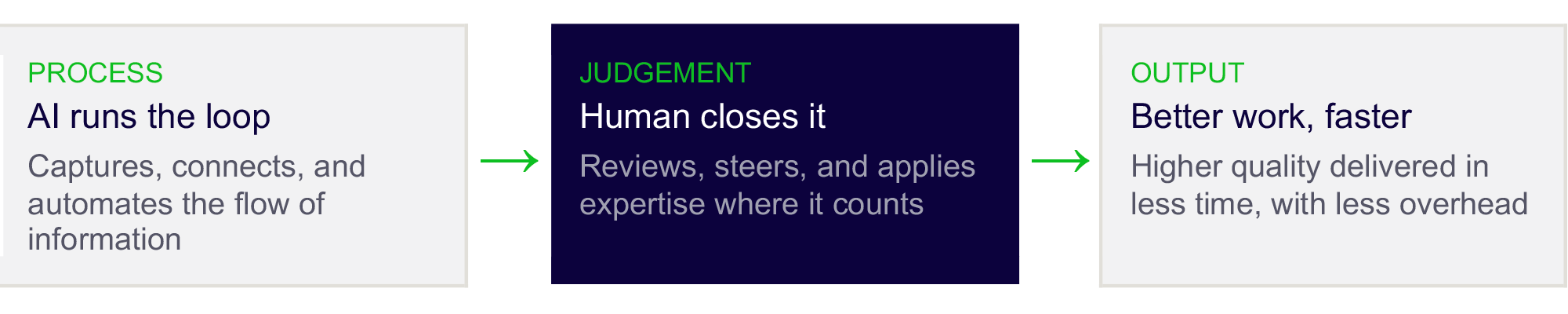
We're deliberate about one thing: AI runs the process, but the human closes it. Every time.
We think of it as the loop. AI is the continuous cycle, capturing information, processing it, connecting it, updating it. But a loop without a closing point just spins. Our engineers are the closing point. They review the outputs, make the calls, and steer the direction. That human judgement is what gives the whole system its value.
This is the part that agencies built on legacy systems tend to misunderstand. They bolt AI onto existing processes and wonder why it doesn't transform them. It doesn't, because you can't retrofit a human-in-the-loop philosophy onto a structure that was never designed for it. That's not a technology problem. It's an architecture problem. And it's not one a lean, purpose-built team has.
The new advantage
The engineering landscape is shifting. The advantage no longer belongs exclusively to the team with the most people or the biggest budget. It belongs to the team that moves quickest, adapts fastest, and operates with the least waste between intention and execution.
At Sketch, GSD is how we make that real. It's a philosophy backed by the right people, the right tools, and a way of working that removes every obstacle between a good idea and a finished result. That's what we bring to every project, and it's what our clients get every time they work with us.
Curious how we work?
If you're looking for an engineering partner who moves at pace without sacrificing rigour, or you want to understand how our approach could work for your team, we'd love to talk.